
Paradoxes of Interactivity: Understanding the Early Modern World Through Historical Simulations
I can’t promise I’ve seen sunlight, but I can promise there’s a reason.
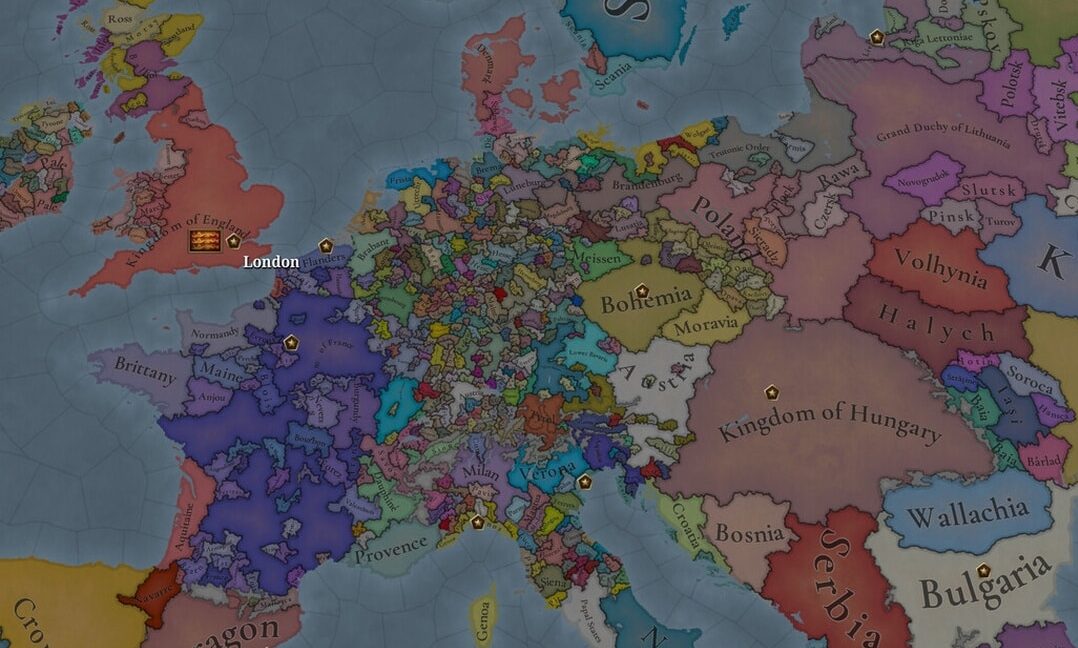
There’s a small, dark room in Waxhaw, North Carolina, where I’ve spent more than 2,000 hours playing Paradox Interactive’s newest game, Europa Universalis V. Count the hours I spent on its predecessor, and I’m over 7,000. Yes—that’s the better part of a year spent playing a single video game. While I can’t promise that I’ve ever seen sunlight, I can promise that there’s a special reason I’ve spent so much time playing Paradox games.
The gameplay of EU5 goes beyond being merely “immersive” or a form of escapism. The game has become such an in-depth, complicated historical simulation, rather than a grand-strategy arcade, that it allows for reflection on historical mechanisms that can only be explored and interacted with in a video game: complex ideas like state formation, the development of markets, and the rise of political ideologies. Its simulation style opens countless possibilities to think critically about history, in a medium that’s unconventional for most academics and scholars.
EU5 wasn’t the first Paradox game to be transformed into a simulation. The 2020s brought a breakthrough that revolutionized how historical grand-strategy games were made: more computing power for the average consumer and developments in coding allowed complex mechanics to emerge in Paradox games. Victoria 3, released in 2022, was one of the first “new-gen” historical simulators from Paradox Interactive. Its predecessor, Victoria 2, had already divided its population into “pops,” groups sorted by profession, culture, and religion, but much of the game still ran on simple, flat modifiers, like a “percentage-growth” bonus. Victoria 3 pushed the pop system much further. Each pop is tied to a specific state and workplace, carries its own consumer needs and political alignment, and counts dependents as well as workers, so that, as one of its developers told Wargamer, the game simulates the entire world’s population rather than just its workforce. (Imperator: Rome, released in 2019, had also experimented with pops on a smaller scale.) In Victoria 3, a pop’s satisfaction and livelihood influence a nation’s economy, which parties get elected, and how productive its workplaces are. Among the pantheon of Paradox games, this was a significant upgrade, and it became the baseline on which future games, like EU5, would be developed.
Continue reading original articleRelated Articles
-

-

- Campus Life
- |
- Opinion
The “Cornell Seven” Is Really About Liberalism
- Columbia University
October 14, 2026 -

- Campus Life
- |
- Higher Ed
- |
- Opinion
Pushing Back Against the Jane Doe Pushback
- Cornell University
October 9, 2026