
Traditions Not Taught at Dartmouth
Samuel W. Lawhon explores how the Lone Pine, though long gone, endures as a symbol of Dartmouth tradition.
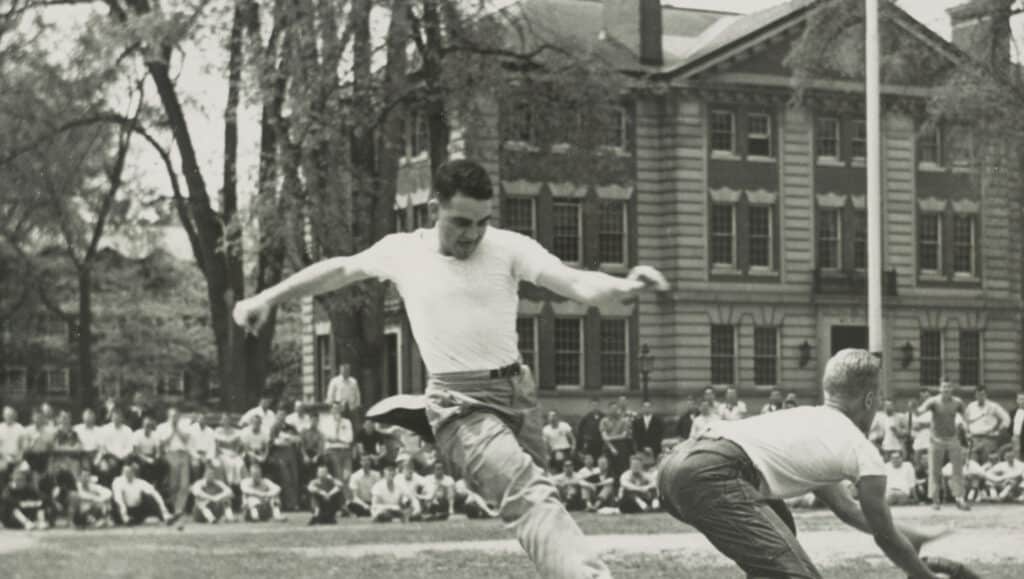
Editor’s Note: The following are obscure aspects of Dartmouth history and lore that have had an observable impact on the College in the present day. The following is in no way a comprehensive list. Rather, the specific traditions and episodes which follow have been selected in order to encourage students to learn more about the College’s history. In other words, pay a visit to Rauner Library!
The Lone Pine
The Lone Pine is an enduring symbol of the College. It refers to a longstanding tree—likely dating back to 1783—which was largely viewed as representative of Dartmouth’s storied history. Only a stump remains today, but the symbol itself lives on.
. . .
The first report about the old tree is an improbable legend. In 1833, an undergraduate named Jacob Gale recounted a story of three Native Americans singing a farewell song while gathered around an ancient pine. However, later investigations showed that three Native Americans never graduated at the same time in the early history of the College.
James F. Joy ’33 later reminisced that there were stories which circulated during his time as an undergraduate about a graduating Class singing “Auld Lang Syne” around the tree before leaving the College.
Ten years later, the Pine was widely known and respected. An alumnus of the Class of 1840 remarked, “Some of us would occasionally, when out for recreation, sing a hymn which tradition told us the three Indians composed and sang.” A member of the Class of 1845 wrote, “We, like other Classes, had many meetings around the ‘Old Pine’ for gossiping, story-telling and music and some other exercises. One of these ‘other exercises’ was a tarring and feathering of a man charged with [a] crime.”
Within a few years, a tradition developed that graduating Classes would celebrate under the tree. From 1854 to 1895, with few exceptions, students would celebrate by singing, giving speeches, smoking a peace pipe, and laying mementos around the Old Pine.
In 1887, the Old Pine was struck by lightning, and in 1892, its main branch was broken in the wind. Finally, in 1895, the tree was cut down. Its stump remains there to this day. In 1967, the symbol was revived in a different form. The Class of 1927 planted the Dartmouth Pine near the entrance to BEMA. The Class later transferred stewardship to the Class of 1967, who ultimately passed care of the tree to the Class of 2007.
Dartmouth Canes
Canes have a long history at Dartmouth. In the eighteenth century, canes were a status symbol among students. Only sophomores and upperclassmen were allowed to carry them. But freshmen would frequently try to assert themselves by flaunting their canes. In response, older students would wrestle freshmen and seize their canes, in a tradition that came to be known as “cane-rush.”
Cane-rush reached its greatest heights in 1883. That year, freshmen took off their shirts and covered themselves in olive oil for a pitched battle with the sophomores. The freshmen stationed themselves on the Green in a protective formation around their prize: a hickory cane. The sophomores then rushed from their base in Reed Hall, beginning a two-hour battle. A student at the time wrote that freshmen who had been knocked unconscious were dragged from the fray by juniors and revived with buckets of cold water. Undeterred, many ran back in. The freshman Class of 1887 eventually lost when the sophomores dragged the prized cane back to Reed Hall. Over time, and not unsurprisingly, the brutal tradition fell out of favor and “cane-rush” died out.
As one cane-related tradition died out, however, another began. When the Class of 1887 graduated, its members bought or fashioned canes to commemorate the occasion and encouraged friends to carve their names into them. In due course, canes became a commercial venture. In 1899, Charles Dudley crafted the first Indian head cane, which became the predominant senior cane until 1974, when the Indian head symbol was eliminated.
Secret societies’ canes are the last vestige of Dartmouth’s long history of cane-related traditions. Every year, approximately twenty percent of graduating seniors carry canes to represent the secret societies with which they are affiliated.
Related Articles
-
- Campus Life
- |
- Free Speech
Strict New Rules Imposed on Campus Organizations
- Cornell University
September 23, 2026 -

-

- Campus Life
- |
- Free Speech
FIRE Grades Cornell with an “F” in the 2027 Free Speech Rankings
- Cornell University
September 19, 2026